Webinars
These webinars are designed to give you practical techniques, based on good neuroscience, that will help you manage challenging situations and problems more effectively. You can benefit both from the powerful effect of using your brain efficiently and from having a tested ‘how to…’ technique that will give you a different approach, a new way of thinking, a new method, new confidence and energy, new behaviours, and better outcomes.
- Why the techniques are useful
- When and where to use them
- How they work in the brain
- How to do them.
How To Handle People Problems (Support or Challenge?) - 31:41
Many people are uncomfortable at the thought of tackling unwanted behaviour in others, fearing that they will provoke a bad reaction and even conflict. Your hosts Jacqy Munro and Mandy Geal explain:
- When and how to act when a problem starts.
- How to describe the unwanted behaviour in such a way that the message will ‘land’ effectively.
- How best to prepare before you have the conversation.
- What technique to use in different situations.
How To Make Best Use Of Your Brain - 13:35
You can benefit from the powerful effect of using your brain efficiently. Your hosts Jacqy Munro and Mandy Geal explain:
- How an essential ‘Attention Switcher’ in the brain affects what you are doing.
- What the Task and People networks it switches between do.
- How to be aware of both networks and when and where best to use them.
- The disadvantages of over-using or under-using each network.
- Finally, how consciously switching between the two to create a balance will make you more effective.
How To Give Motivating Feedback - 19:31
Regular and effective feedback can improve confidence and performance and prevent problems with behaviour and skill occurring or continuing. Your hosts Jacqy Munro and Mandy Geal explain:
- Examples of when giving feedback is appropriate.
- How the way you give feedback affects the brain, positively and negatively.
- How to phrase questions and statements when giving feedback to ensure the effect is constructive and impactful.
- How you can use feedback even when you are not a manager.
Manage People Effectively - 16:05
Managing people effectively is essential but can be time consuming, but your hosts Jacqy Munro and Mandy Geal explain:
- A systematic approach to save you time and maximise effectiveness.
- 5 key questions your team will want you to answer as their manager.
- How to change your management style so you give the right amount and type of input for each member of your team and how you might need to adapt it when they are in different situations.
- How changing your style will get the best from your team.
How To Build Your Confidence - 16:56
Feeling confident in a situation can lead to good results and can help maintain and increase your energy levels. Your hosts Jacqy Munro and Mandy Geal explain:
- How different sources of ‘opinions’ and comment might affect your confidence.
- How self-confidence works in the brain.
- How to think of yourself in a way that will build your self-confidence.
- What to do to generate trust and confidence in yourself.
How To Disagree Without Being Disagreeable - 17:20
You will need to disagree with someone at some point, perhaps to prevent something unhelpful happening, and/or to contribute assertively to a situation. Your hosts Jacqy Munro and Mandy Geal explain:
- How disagreement can happen without hooking the threat system in the brain.
- 3 steps for structuring your disagreement effectively.
- How, if you signal some agreement in the situation (however small), it can keep the other person’s mind open to agreeing with you instead.
- How and why phrasing your alternative idea as a question means it is more likely to be agreed with by others.
How To Empathise With A 'Difficult' Person - 19:54
It can be very difficult to empathise with someone when you see them as being ‘difficult’. Your hosts Jacqy Munro and Mandy Geal explain:
- Why empathising in these circumstances is the most helpful thing to do.
- What happens in the brain that stops empathy and how you can keep empathy working.
- How to show empathy.
- How to use empathy to support (empathy…and), and to challenge (empathy…but).
How To Make A Good Decision In A Group - 28:28
It can be harder to make a good decision with a group and an effective process can be very useful, saving time, reducing disagreement, and increasing engagement. Your hosts Jacqy Munro and Mandy Geal explain:
- Why and how different people process information in a different way.
- How to control the way information is communicated so it happens efficiently.
- How to follow a 3 step process for making a good decision.
- An efficient and effective way of analysing a decision and choosing the best option.
How To Say 'No' - 15:12
Many people have difficulty saying no. Your host Jacqy Munro explains:
- How to rethink your attitude so that you feel you have the right to say no.
- How to think assertively about saying no.
- How to be clear what is inside and outside your job scope to help you to decide.
- How to actually say it so that you get a good response.
How To Make A Conversation Effective - 15:55
Things get lost in translation, and even when you supposedly reach agreement you might have different ideas about what was just talked about. In this webinar, your host Jacqy Munro explains:
- How having a purpose for a conversation is important, with ideas about what that might be.
- How building rapport will help the conversation flow.
- How showing empathy will lead to a deeper level of engagement.
- How managing and controlling the level of detail will make the conversation efficient.
How To Work Out What's Stressing You - 25:26
Working out what is stressing you is a major step forward to dealing with the stress as it puts you in a position to take some action. It is helpful, but not essential, that you have already watched the videos 'The Chimp Brain' and 'The Human Brain'. In this webinar, your host Jacqy Munro explains:
- What is happening when you are stressed.
- How to understand the effects of stress.
- Some typical triggers that cause stress.
- A process for self-reassurance.
How To Run A Good Meeting - 21:51
Hours of time are wasted in inefficient meetings. In this webinar, your host Jacqy Munro explains:
- A different way of thinking about meetings that highlights where your effort is best placed to improve them.
- Guidelines for running an effective meeting if you are the organiser.
- Your role if running the meeting.
- Tips for making the discussion more effective.
How To Prepare For A Presentation - 15:53
Many people are anxious about giving a presentation. Preparation for any presentation is key to its success. Your host Jacqy Munro explains:
- Tips for success before a presentation.
- Key attributes for a good presentation.
- How to gather and plan the content.
- Examples of good structure.
How To Create A Good Development Plan - 22:32
- The conditions for a good development plan and the importance of specific feedback and analysis.
- The key steps in creating a good plan.
- How to use the Train Station as a resource for writing the development objective and indicators of success.
- How to use the Train Station resources to choose precisely the right techniques and actions and build this into practice that accelerates your development.
How To Manage Your Time To Get Things Done - 25:12
- How to avoid common pitfalls that contribute to stress and inefficiency.
- Principles of a good time management approach.
- The ‘’Getting Things Done Process for recording tasks and managing your time and diary.
- What to do differently overall to get started straight away for a more successful and effective approach to time management.
How To Prioritise - 28:07
- How some of your personality preferences will be affecting how you prioritise helpfully, and hindering a better approach.
- A technique for identifying your task list effectively and realistically.
- A prioritising technique that is helpful for everyone.
How To Prepare To Influence Someone - 25:49
- How to use an Influencing Situation Plan to engage others effectively.
- What values are and how to identify and use them to influence.
- How to organise information systematically and efficiently to present your case.
- Different influencing styles and when to use each one to best advantage.
How To Start a 121 Catch Up - 12:58
Regular catch ups are essential for maintaining a good relationship between a manager and the team member. Managers often worry that they will take too long, or don't know how to them. In this companion webinar to Manage People Effectively your hosts Mandy Geal and Jacqy Munro explain and demonstrate:
- The 5 Questions Model for managing performance through regular catch ups.
- What other resources are available on the Train Station to help you as a manager or someone taking part in a catch up conversation.
- Tips for running the catch up effectively.
- How to frame the conversation and put the team member at ease.
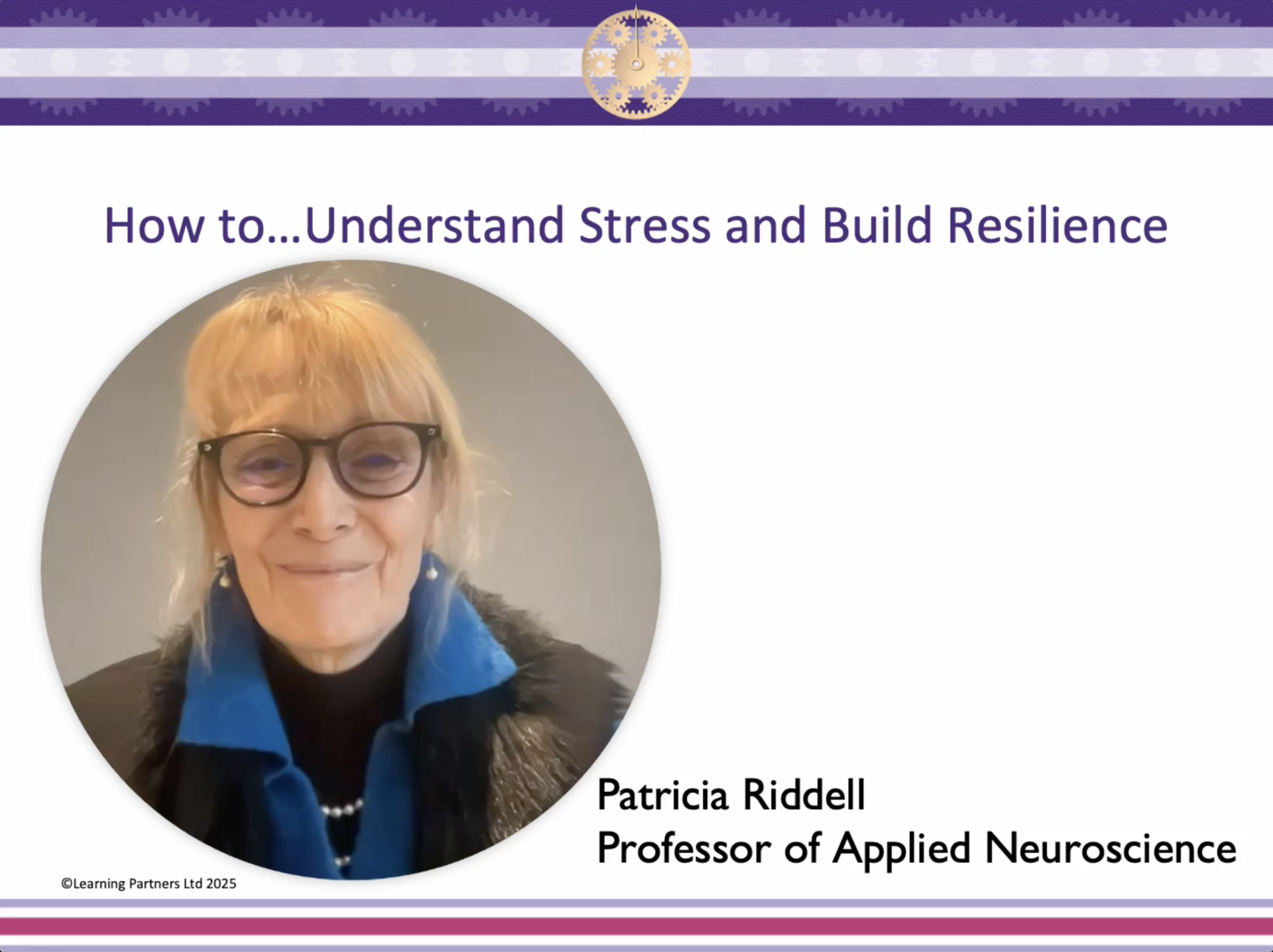
How To Understand Stress and Build Resilience - 16:51
The aim of this webinar is to help managers and leaders to be better able to manage their own stress and help their teams manage stress more effectively. Patricia Riddell, Professor of Applied Neuroscience, explains:
- What happens when we perceive stress
- Triggers for stress – the story we tell ourselves
- What is good stress, tolerable stress, and toxic stress and their effects on us
- Some techniques to recognise and manage stress
- Recommendations to build resilience and relieve depressive or anxious symptoms.